One of the first questions businesses ask when considering a mobile application is also one of the hardest to answer:
How much does it cost to build a mobile app?
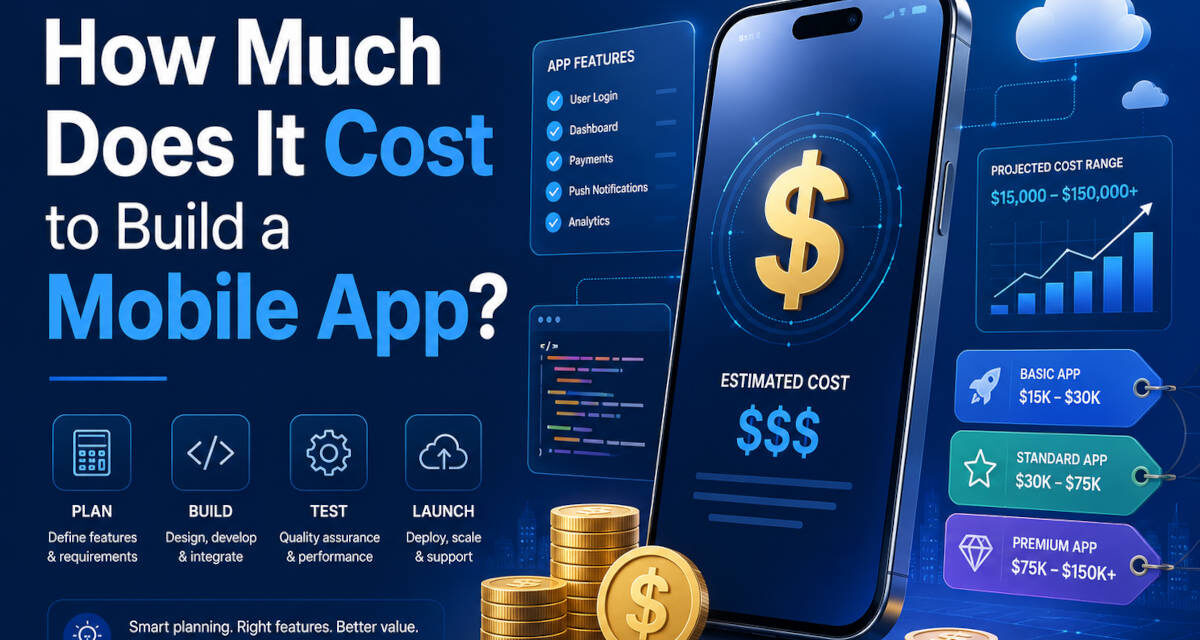
The short answer is that a professionally developed mobile application can cost anywhere from $15,000 for a relatively simple application to $250,000 or more for a complex business platform.
Enterprise applications, large consumer platforms, healthcare systems, financial applications, AI-powered products, and applications supporting millions of users can easily go considerably higher.
Current industry data illustrates just how wide the range can be. Clutch reports that many mobile application projects reviewed on its platform fall between $10,000 and $49,999, while GoodFirms estimates that mobile application development in 2026 can range from approximately $15,000 to $500,000 or more.
That range is enormous because asking what an app costs is similar to asking:
How much does it cost to build a house?
A 1,200-square-foot starter home and a 10,000-square-foot custom home are technically both houses, but they are completely different engineering and construction projects.
Mobile apps work the same way.
The cost depends on what the application needs to do, how many systems it communicates with, how much data it processes, how secure it needs to be, and how much infrastructure exists behind the screens users see.
Typical Mobile App Development Costs in 2026
For early budgeting, businesses can generally think about mobile application development in several categories.
Simple Mobile App: $15,000–$35,000
A relatively simple application may include:
- A limited number of screens
- Basic user accounts
- Static or lightly dynamic content
- Simple forms
- Basic database functionality
- Push notifications
- Limited API integration
- Basic administrative functionality
Examples could include an internal company application, simple customer portal, event application, field-data collection tool, or application that primarily displays information from an existing system.
Small Business or MVP App: $25,000–$60,000
An MVP, or Minimum Viable Product, contains enough functionality to launch the product and validate the business concept without building every possible feature.
It might include:
- User registration and login
- Customer profiles
- Database-driven content
- API integrations
- Push notifications
- Location services
- Basic payment functionality
- Administrative dashboard
- Analytics
- Apple App Store deployment
- Google Play deployment
The purpose of an MVP is not necessarily to create a cheap application.
The purpose is to identify the smallest technically sound version of the product that produces business value.
For many organizations, this is the best way to begin.
Moderate Business Application: $50,000–$120,000
Once an application becomes integrated with other business systems, development becomes considerably more involved.
Applications in this category may include:
- Multiple user roles
- Complex authentication
- Customer dashboards
- CRM integration
- ERP integration
- Payment processing
- Subscription billing
- Mapping
- GPS functionality
- Real-time notifications
- Document management
- File uploads
- Image processing
- Reporting
- Administrative portals
- Custom APIs
- Offline functionality
At this level, the project is no longer simply a mobile interface.
It is becoming a complete software platform.
Complex Mobile Platform: $100,000–$250,000+
Complex applications often involve multiple software systems working together.
Examples include:
- Marketplace applications
- Delivery platforms
- Healthcare applications
- Financial applications
- Social networking platforms
- Transportation applications
- Logistics systems
- Large field-service platforms
- IoT applications
- AI-powered applications
These applications can require extensive server infrastructure, complex databases, sophisticated permission systems, security auditing, real-time communication, cloud services, and multiple third-party integrations.
Enterprise Mobile Application: $250,000+
Large enterprise applications may involve dozens of developers, designers, analysts, security specialists, DevOps engineers, QA specialists, and project managers.
The mobile application itself may only represent a small portion of the overall system.
A large enterprise application could include:
- iOS application
- Android application
- Web application
- Administrative portal
- API platform
- Cloud infrastructure
- Identity management
- Enterprise integrations
- Data warehouses
- Reporting systems
- AI services
- Security monitoring
- Automated testing
- Compliance systems
For these projects, development may continue for years rather than months.
The Mobile App Is Often Only Part of the Project
One of the biggest misconceptions about mobile development is that developers are simply creating screens that run on a phone.
In reality, many mobile applications are front ends for considerably larger software systems.
Imagine a customer opens an app and presses:
View My Orders
That one button might require the mobile application to communicate with:
- An authentication server
- A custom API
- A customer database
- An inventory system
- A payment processor
- A shipping provider
- A CRM
- A notification service
What looks like a simple screen to the customer can involve substantial back-end engineering.
This is why estimating an application based entirely on the number of screens can be misleading.
What Determines the Cost of a Mobile App?
Several technical factors have the greatest impact on development cost.
1. Native vs. Cross-Platform Development
One of the first architectural decisions is how the application will be developed.
Native Development
Native applications are developed specifically for each operating system.
Apple applications generally use technologies such as Swift and SwiftUI, while Android applications commonly use Kotlin and Jetpack Compose.
If you build separate native applications for both platforms, you may effectively be maintaining two application codebases.
Native development can be appropriate when an application requires:
- Maximum performance
- Extensive hardware integration
- Advanced Bluetooth functionality
- Complex background processing
- Advanced graphics
- Specialized camera functionality
- Heavy operating-system integration
The tradeoff is that maintaining separate platforms can increase development and testing costs.
Cross-Platform Development
Technologies such as React Native and Flutter allow developers to share significant portions of code between iOS and Android.
That does not mean the exact same code runs everywhere without modification.
Platform-specific development is still frequently required.
However, cross-platform frameworks can significantly reduce duplicated development effort for many business applications.
2. Back-End Development
Many mobile applications require a server-side application.
The back end might manage:
- Users
- Authentication
- Products
- Orders
- Messages
- Documents
- Images
- Notifications
- Permissions
- Business rules
It may also provide the API through which the mobile application communicates with the system.
A simple application using an existing API might require very little back-end development.
A custom business application requiring an entirely new platform could require more back-end development than mobile development.
3. API Integrations
Modern applications rarely operate in isolation.
They often integrate with third-party platforms such as:
- Salesforce
- HubSpot
- Stripe
- QuickBooks
- Microsoft 365
- Google Workspace
- Shopify
- Twilio
- SendGrid
- DocuSign
- Mapping platforms
- Shipping providers
- Internal enterprise software
An API integration can take a few hours or hundreds of hours depending on its complexity.
A well-documented modern REST API may be relatively straightforward.
Integrating with an undocumented legacy system built 15 years ago can be an entirely different project.
4. User Accounts and Authentication
Authentication can range from extremely simple to extremely complex.
Basic systems might require only:
- Password
- Password reset
More advanced environments might require:
- Multi-factor authentication
- Social login
- Google authentication
- Apple authentication
- Microsoft authentication
- Single Sign-On
- OAuth
- SAML
- Enterprise identity providers
- Role-based access
- Device authentication
- Biometric authentication
Security requirements often increase development and testing requirements considerably.
5. Payment Processing
Accepting payments inside a mobile application introduces another level of complexity.
The application may need to manage:
- Credit cards
- Apple Pay
- Google Pay
- Subscription billing
- Recurring payments
- Refunds
- Coupons
- Taxes
- Invoices
- Marketplace payments
There are also important differences between payments for physical goods and services and payments for digital content consumed inside an application.
Apple and Google maintain their own rules regarding in-app purchasing, which must be considered during application architecture.
6. Administrative Software
Businesses frequently budget for the mobile application but forget the administrative interface.
Someone usually needs to manage the system.
That may require a web-based administration portal allowing employees to:
- Manage customers
- Update products
- Review transactions
- Approve accounts
- Upload files
- Change application content
- Run reports
- Send notifications
- Manage permissions
Depending on the project, the administrative portal can become a substantial software application of its own.
7. UI and UX Design
There is a major difference between technically functional software and polished commercial software.
Professional UI/UX work can include:
- User research
- User flows
- Wireframes
- Interactive prototypes
- Interface design
- Responsive layouts
- Accessibility
- Usability testing
- Design systems
A heavily branded consumer application typically requires considerably more design work than an internal application used by 20 employees.
8. Real-Time Features
Real-time functionality increases infrastructure complexity.
Examples include:
- Messaging
- Live tracking
- Driver locations
- Collaborative editing
- Real-time dashboards
- Live bidding
- Multiplayer functionality
- Video communication
A delivery app that displays the driver’s current location is fundamentally more complicated than an application displaying yesterday’s delivery information.
9. Offline Functionality
Offline applications can be surprisingly difficult to build.
Suppose technicians use an application in locations without internet access.
The app may need to store information locally and then synchronize with the server once internet connectivity returns.
Now developers must solve problems such as:
What happens if the same record changes on the server while the technician is offline?
Which version wins?
What happens if synchronization is interrupted?
Offline synchronization can become one of the most complicated parts of a business application.
10. Security and Compliance
Applications managing sensitive information require additional engineering.
Examples include applications dealing with:
- Healthcare information
- Financial information
- Employee information
- Personally identifiable information
- Credit card information
Security may require encryption, audit logging, access controls, monitoring, data retention policies, secure APIs, vulnerability testing, and additional infrastructure.
Security should be part of the architecture from the beginning rather than something added immediately before launch.
How Much Do Mobile App Developers Charge?
Hourly rates vary dramatically depending on experience, geography, employment model, and specialization.
Clutch’s July 2026 pricing guide reports that many mobile application development companies listed on its marketplace charge approximately $25–$49 per hour, although U.S.-based firms and specialized development teams can charge substantially more. Individual U.S. agency listings frequently show rates in the $75–$150+ range.
Freelance marketplaces can show lower numbers. Upwork currently reports typical mobile application developer rates of approximately $18–$39 per hour, with higher rates possible for specialized and experienced developers.
However, hourly rate alone is usually a poor way to select a development team.
Consider two developers:
Developer A: $40/hour and requires 800 hours.
Developer B: $100/hour and requires 250 hours.
Developer A costs:
$32,000.
Developer B costs:
$25,000.
The more expensive developer is actually cheaper.
Experience can also prevent expensive architectural mistakes that do not become obvious until late in the project.
Does AI Make Mobile App Development Cheaper?
AI is changing software development, but it has not eliminated software engineering.
AI coding tools can help developers:
- Generate boilerplate code
- Create unit tests
- Research APIs
- Debug code
- Produce documentation
- Refactor repetitive code
- Prototype interfaces
- Accelerate routine programming tasks
This can improve development productivity.
However, AI does not eliminate the need to determine:
- What should be built
- How the architecture should work
- How data should be structured
- How systems should communicate
- How security should be implemented
- How errors should be handled
- How the software should scale
- Whether generated code is correct
In fact, industry research published in 2026 identifies AI as both a potential productivity improvement and a new source of application complexity, particularly when custom AI functionality is part of the product itself.
Building an AI chatbot on top of an existing model can be relatively simple.
Building a secure AI system that accesses proprietary company information, understands user permissions, searches multiple databases, maintains conversation context, and performs business actions is considerably more complex.
Why Cheap App Development Can Become Expensive
Businesses sometimes receive development estimates that differ by 300%, 500%, or even 1,000%.
There can be legitimate reasons.
But sometimes the least expensive quote simply leaves things out.
A $15,000 proposal and a $60,000 proposal might not actually describe the same application.
Ask whether the estimate includes:
- UI/UX design
- iOS development
- Android development
- Back-end development
- Database design
- API development
- Administrative portal
- Quality assurance
- Project management
- App Store submission
- Google Play submission
- Cloud deployment
- Analytics
- Source code
- Documentation
- Post-launch support
The cheapest initial proposal can become extremely expensive when these items begin appearing as change orders.
How Long Does It Take to Build a Mobile App?
A small application might be completed in two or three months.
A moderate business application might require four to eight months.
Large applications can require a year or longer.
Schedule and cost are closely connected.
Trying to reduce a six-month project to three months does not necessarily reduce the cost.
It may increase it because additional developers, coordination, testing, and project management are required.
This is sometimes described as the mythical man-month problem: software development work cannot always be accelerated simply by adding more developers.
Don’t Forget Ongoing Mobile App Costs
Launching the application is not the end of the project.
Applications require ongoing maintenance.
Typical expenses may include:
- Cloud hosting
- Database hosting
- File storage
- Email services
- SMS services
- Mapping APIs
- Monitoring
- Security updates
- Operating-system updates
- API updates
- Bug fixes
- New features
- App Store maintenance
- Google Play maintenance
Third-party services may also charge based on users, transactions, bandwidth, storage, or API requests.
A good development estimate should distinguish between initial development costs and ongoing operating costs.
How Can You Reduce Mobile App Development Costs?
The best way to reduce development cost is usually not to find the cheapest programmer.
It is to reduce unnecessary complexity.
Start With an MVP
Determine which features must exist at launch and which can wait.
If twelve features are planned but only six are necessary to validate the business idea, build those six first.
Use Existing Services
There is rarely a good reason to build commodity infrastructure from scratch.
Existing platforms can provide:
- Payment processing
- Authentication
- Messaging
- Video
- Mapping
- Cloud storage
- Analytics
Using established services can dramatically reduce development effort.
Use Cross-Platform Development When Appropriate
For many business applications, a framework such as Flutter or React Native can reduce the amount of duplicated development between iOS and Android.
It is not appropriate for every project, but it should usually be evaluated.
Define Requirements Before Development
One of the most expensive ways to build software is:
Start coding and figure it out later.
A discovery and architecture phase can identify expensive problems before developers spend months implementing the wrong solution.
A Better Question Than “How Much Does an App Cost?”
Instead of asking:
How much does it cost to build a mobile app?
A more useful question is:
What is the least expensive version of this application that accomplishes our business objective without creating technical problems later?
That question changes the development conversation.
Features can be divided into:
Required for launch
These are necessary for the product to function.
Important but not required
These improve the product but can potentially be added later.
Future enhancements
These should be deliberately postponed.
This approach reduces the initial investment while creating a roadmap for future development.
Example Mobile App Budget
Consider a company building a customer-service application.
The first version requires:
- iPhone application
- Android application
- Customer login
- Customer profiles
- Service requests
- Photo uploads
- Push notifications
- Existing CRM integration
- Administrative dashboard
A realistic planning budget might be roughly:
- Discovery and architecture: $3,000–$8,000
- UI/UX design: $5,000–$12,000
- Mobile development: $20,000–$45,000
- Back-end/API development: $10,000–$25,000
- Administration portal: $8,000–$20,000
- Testing and deployment: $5,000–$12,000
That places the project roughly in the $50,000–$120,000 range.
These numbers are not fixed industry prices. They are an example of how a legitimate business application budget can be constructed.
Change the requirements and the price changes immediately.
If the existing CRM already provides excellent APIs, the integration could be relatively easy.
If the CRM is a custom system built in 2004 with no API, integration could become one of the most expensive portions of the project.
That is why serious application estimates require technical discovery.
Final Thoughts
So, how much does it cost to build a mobile app?
For planning purposes in 2026, businesses can generally think about budgets like this:
Simple application: $15,000–$35,000
MVP or small business application: $25,000–$60,000
Moderate custom business application: $50,000–$120,000
Complex application: $100,000–$250,000+
Enterprise platform: $250,000+
The important point is that the mobile application itself does not determine the cost. The system behind it does.
Database architecture, APIs, integrations, security, administrative tools, authentication, payments, cloud infrastructure, and business rules often represent as much development work as the screens running on the phone.
That is also why a good development company should not immediately quote a price after hearing a two-sentence description of an idea.
The first step should be understanding the business problem, defining the application’s requirements, identifying existing systems, and determining the correct technical architecture.
Once those pieces are understood, a realistic development budget can be created—and the business can decide which features provide enough value to justify the investment.
Need an Estimate for a Mobile App Project?
If your company is considering a mobile application, start by defining what the application needs to accomplish rather than trying to determine every possible feature.
A good development team can help turn those requirements into an architecture, identify expensive components early, determine what belongs in the first release, and create a realistic development roadmap.
That process can often save considerably more money than simply searching for the lowest hourly development rate.