
If you run a local service business, online advertising can be one of the fastest ways to generate new leads. The challenge is deciding where to spend your advertising budget.
Two of the biggest options are Google Ads and Facebook Ads.
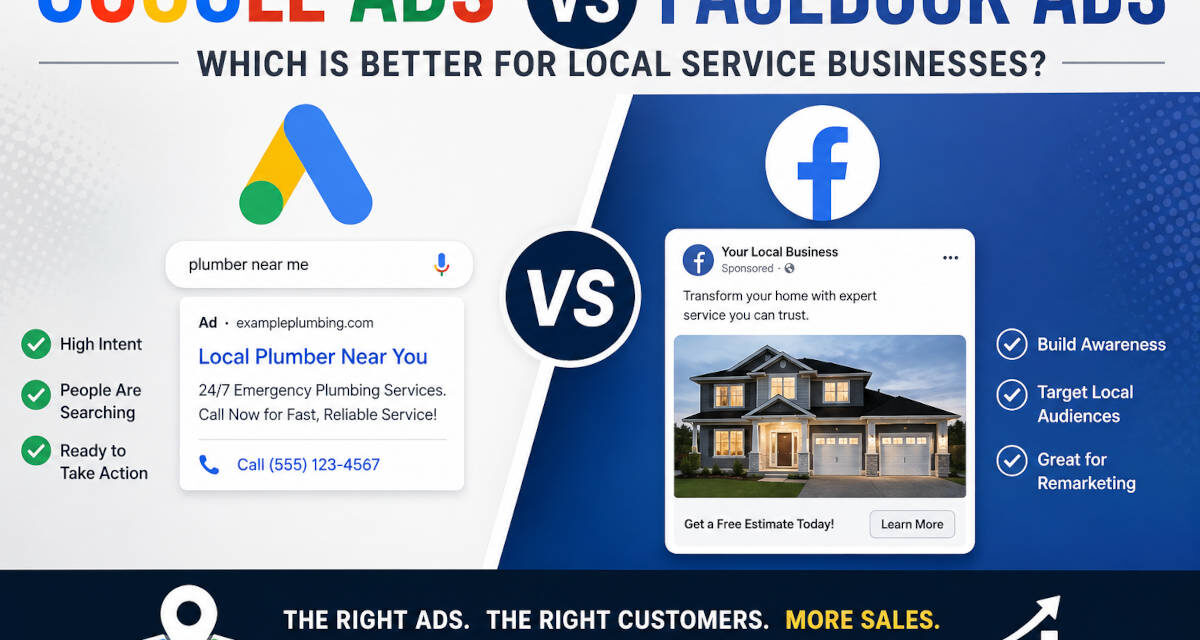
Both platforms can generate customers, but they work very differently. Google Ads typically reaches people who are actively searching for a service, while Facebook Ads are often better at putting your business in front of potential customers before they begin searching.
For plumbers, electricians, contractors, landscapers, HVAC companies, attorneys, cleaning companies, home improvement companies, and other local service businesses, understanding this difference can have a major impact on your advertising results.
So which is better: Google Ads or Facebook Ads?
For many local service businesses, the answer is Google Ads. However, there are situations where Facebook Ads can perform extremely well, and combining the two platforms can sometimes deliver the best overall results.
What Is Google Ads?
Google Ads allows businesses to advertise on Google search results and across Google’s advertising network.
For most local service companies, search advertising is the most important part of Google Ads.
For example, someone might search Google for:
- plumber near me
- emergency AC repair
- deck builder in Austin
- roof repair company
- house painter near me
- local electrician
- kitchen remodeling contractor
Businesses can bid to have their advertisements appear near the top of the search results for these searches.
This gives Google Ads one major advantage: search intent.
The person searching for “emergency plumber near me” probably isn’t casually researching plumbing. There is a good chance they need a plumber right now.
That makes Google Ads extremely powerful for businesses that provide services customers actively search for.
What Are Facebook Ads?
Facebook Ads are advertisements that appear across Facebook and other Meta platforms, including Instagram.
Instead of primarily targeting people based on what they are currently searching for, Facebook Ads allow businesses to target audiences using factors such as location, demographics, interests, behaviors, and previous interactions with a business.
For example, a local remodeling company might show an advertisement to homeowners within 20 miles of its service area.
The homeowner may not currently be searching for a remodeling contractor, but an attractive before-and-after photo of a kitchen renovation might get their attention.
Facebook advertising is therefore often more about creating demand, while Google Search Ads are commonly used to capture existing demand.
Google Ads Targets People Looking for Your Service
One of the biggest advantages Google Ads offers local businesses is timing.
Suppose someone’s air conditioner stops working during the middle of summer.
Their first reaction probably isn’t to open Facebook and wait for an HVAC advertisement to appear.
They are much more likely to search Google for something like:
“AC repair near me”
A properly configured Google Ads campaign allows an HVAC company to appear at exactly that moment.
This is why Google Ads can be particularly effective for services involving immediate problems or strong purchase intent.
Examples include:
- Plumbing
- HVAC repair
- Electricians
- Pest control
- Roofing
- Appliance repair
- Auto repair
- Locksmith services
- Water damage restoration
- Legal services
- Tree removal
Customers searching for these services often already know what they need.
Your advertisement simply needs to convince them to contact your company instead of a competitor.
Facebook Ads Are Better at Getting Attention
Facebook Ads work differently.
People generally aren’t opening Facebook or Instagram specifically because they need a contractor, plumber, or landscaper.
Instead, they are scrolling through photos, videos, news, and posts from friends.
Your advertisement interrupts that experience.
That means the ad needs to attract attention.
Businesses offering highly visual services often have an advantage on Facebook and Instagram.
Examples include:
- Landscaping
- Swimming pool installation
- Deck construction
- Kitchen remodeling
- Bathroom remodeling
- Interior design
- Painting
- Flooring
- Outdoor kitchens
- Home additions
Photos and videos showing dramatic transformations can work particularly well.
A homeowner who wasn’t actively searching for a new deck might suddenly start thinking about one after seeing a great-looking backyard transformation.
Google Ads vs Facebook Ads for Buyer Intent
Buyer intent is one of the biggest differences between the two advertising platforms.
Consider these two potential customers.
The first person searches:
“deck contractor near me”
The second person sees a Facebook advertisement showing a beautiful custom deck.
Both could eventually become customers, but the first person is probably much further along in the buying process.
They are already searching for a contractor.
This usually gives Google Ads an advantage when your goal is generating leads quickly.
Facebook Ads may require more advertising impressions and additional follow-up before someone becomes a customer.
Which Platform Produces Better Leads?
Lead quality depends heavily on the industry, advertising strategy, website, geographic area, and campaign setup.
However, Google Ads often produces stronger immediate leads for local service businesses because the customer initiated the search.
Someone typing “foundation repair company near me” is clearly expressing interest in foundation repair.
Facebook targeting cannot always determine whether someone actually needs foundation repair right now.
Facebook may generate cheaper leads in some industries, but cheaper leads do not automatically mean better leads.
A contractor might receive 50 Facebook leads at $20 each while another campaign generates 20 Google Ads leads at $50 each.
Both campaigns cost $1,000.
If the Google leads result in more appointments and larger sales, Google could still be the better investment.
The most important metric isn’t simply cost per lead.
Businesses should ultimately measure:
- Cost per qualified lead
- Appointment rate
- Close rate
- Average sale
- Customer acquisition cost
- Revenue generated
- Return on advertising spend
Google Ads Can Be More Expensive
The biggest drawback to Google Ads is competition.
Businesses are bidding against other advertisers for valuable search terms.
Competitive industries can have expensive clicks, particularly in large metropolitan areas.
A search involving a high-value service could cost significantly more than a Facebook click.
But cost per click isn’t necessarily the most important number.
Imagine paying $15 for a Google Ads click from someone actively searching for a $10,000 home improvement project.
That click could potentially be much more valuable than several inexpensive social media clicks from people who aren’t currently looking for the service.
The real question should be:
How much does it cost to acquire a paying customer?
Facebook Ads Can Reach More People for Less
Facebook advertising can often generate a large number of impressions relatively inexpensively.
This makes Facebook useful for building local awareness.
A new contractor entering a market, for example, could target homeowners throughout its service area with photos of completed projects.
Over time, local homeowners may begin recognizing the company’s name.
Then, when they eventually need that service, the company may already feel familiar.
This type of advertising can be difficult to measure compared with direct-response search advertising, but it can still play an important role in a broader marketing strategy.
Facebook Ads Are Great for Remarketing
One of the best ways local businesses can use Facebook Ads is remarketing.
Remarketing allows businesses to advertise to people who have previously interacted with them.
For example, someone searches Google for:
“bathroom remodeling contractor”
They click your Google advertisement and visit your website.
They look at your remodeling portfolio but don’t fill out the contact form.
Later that evening, they open Facebook or Instagram.
Now they see an advertisement from your remodeling company showing another completed bathroom project.
That second interaction can remind them about your business and encourage them to return.
This is where Google Ads and Facebook Ads can work extremely well together.
Google captures the initial search.
Facebook helps keep your company in front of the potential customer.
Google Ads Works Well With Local SEO
Google Ads can also complement a local SEO strategy.
Search engine optimization is designed to improve your organic visibility in Google search results.
However, SEO takes time.
A newer website might need months before it ranks competitively for important local searches.
Google Ads allows a business to begin appearing for those searches almost immediately.
Businesses can also use advertising data to help guide their SEO strategy.
For example, if certain search phrases consistently generate profitable leads through Google Ads, those keywords may also make good targets for service pages and blog content.
Over time, the combination of SEO and paid search can give a local company significantly more exposure in Google.
Facebook Ads Can Create Demand for Services People Don’t Search for Often
Not every service generates large numbers of Google searches.
Some services are highly specialized.
Others are purchases customers don’t think about until they see them.
Facebook can be especially effective in these situations.
For example, homeowners may not regularly search for:
“custom backyard outdoor kitchen installer”
But they might stop scrolling when they see an advertisement showing an impressive outdoor kitchen.
The advertisement creates interest.
This makes Facebook especially valuable for visually attractive or discretionary services.
Which Is Better for Emergency Services?
Google Ads is usually the stronger choice for emergency services.
If someone has:
- A leaking pipe
- A broken air conditioner
- A damaged roof
- A locked car
- A flooded home
- An electrical problem
They are probably searching for immediate help.
These customers are unlikely to wait until they happen to see an advertisement on social media.
Google Ads can connect the business with the customer at the exact moment the problem occurs.
Which Is Better for Remodeling and Home Improvement?
For home improvement companies, the answer can be both.
Google Ads can target homeowners actively looking for contractors.
Facebook and Instagram can showcase finished projects that generate interest.
A remodeling company could use Google Ads to target searches such as:
- kitchen remodeling contractor
- bathroom remodeler near me
- home addition contractor
- custom deck builder
At the same time, it could run Facebook and Instagram ads showing project photos and videos.
This creates both direct-response advertising and brand awareness.
Should Local Businesses Start With Google Ads or Facebook Ads?
If advertising budgets are limited, many local service businesses should consider starting with Google Search Ads.
The reason is simple.
Google allows you to target people who are already looking for your service.
Once the Google Ads campaign is producing consistent leads, Facebook Ads can be added for remarketing, brand awareness, and additional customer acquisition.
There are exceptions.
A company providing a visually impressive service, such as landscaping, pools, remodeling, or outdoor living projects, may find Facebook and Instagram highly effective from the beginning.
Don’t Send Paid Traffic to a Bad Website
The advertising platform is only part of the equation.
Both Google Ads and Facebook Ads can fail if visitors arrive on a poorly designed website.
Your landing page should make it immediately clear:
- What services you provide
- Where you provide them
- Why customers should choose your company
- How they can contact you
- What they should do next
Phone numbers and contact forms should be easy to find.
The website should also work properly on mobile devices.
Many local service searches happen on smartphones, particularly when customers need help quickly.
A slow or confusing mobile website can waste expensive advertising clicks.
Tracking Phone Calls and Form Submissions Is Essential
One of the biggest mistakes businesses make with online advertising is failing to track conversions properly.
Clicks don’t pay the bills.
Customers do.
Businesses should track actions such as:
- Phone calls
- Contact form submissions
- Appointment requests
- Quote requests
- Online bookings
Ideally, businesses should also track which leads eventually become paying customers.
Without conversion tracking, it can be difficult to determine whether Google Ads or Facebook Ads is actually generating revenue.
Google Ads vs Facebook Ads: Pros and Cons
Google Ads Advantages
Google Ads is particularly strong because it can:
- Reach customers actively searching for your service
- Generate high-intent leads
- Target specific geographic areas
- Target specific keywords
- Produce leads quickly
- Work especially well for emergency services
- Complement local SEO
Google Ads Disadvantages
Potential disadvantages include:
- Competitive keywords can be expensive
- Poor keyword targeting can waste money
- Campaigns require ongoing management
- Competitors may aggressively bid on the same searches
Facebook Ads Advantages
Facebook Ads can:
- Reach large local audiences
- Build brand awareness
- Showcase visual projects
- Generate demand
- Target homeowners and demographic groups
- Retarget previous website visitors
- Work well with video and before-and-after photos
Facebook Ads Disadvantages
Potential disadvantages include:
- Users may not currently need your service
- Lead quality can vary
- Customers may be earlier in the buying process
- Ads need strong creative content to get attention
Google Ads and Facebook Ads Work Better Together
The debate doesn’t necessarily need to be Google Ads or Facebook Ads.
For businesses with enough advertising budget, the strongest approach may be using both.
A simple strategy might look like this:
Step 1: Google Search Ads
Capture people actively searching for your services.
Step 2: Landing Page
Send visitors to a page specifically designed to convert them into leads.
Step 3: Remarketing
Use Facebook and Instagram advertising to stay in front of visitors who didn’t immediately contact you.
Step 4: Local SEO
Build organic search visibility so your business becomes less dependent on paid advertising over time.
This allows each marketing channel to serve a different purpose.
Google Ads vs Facebook Ads: Which Should You Choose?
For most local service businesses looking to generate sales quickly, Google Ads is usually the better place to start.
Google’s biggest advantage is intent.
When someone searches for a service your company provides, you have an opportunity to reach them precisely when they are considering making a purchase.
Facebook Ads can still be extremely valuable, particularly for visually appealing services, brand awareness, promotions, and remarketing.
Instead of thinking of the platforms as competitors, businesses should consider how each can fit into their overall marketing strategy.
Google can help people find your business when they need you.
Facebook can help make sure they remember your business before they make their final decision.
For many local companies, combining paid search, social advertising, and local SEO can create a steady pipeline of new leads while building long-term visibility in the market.