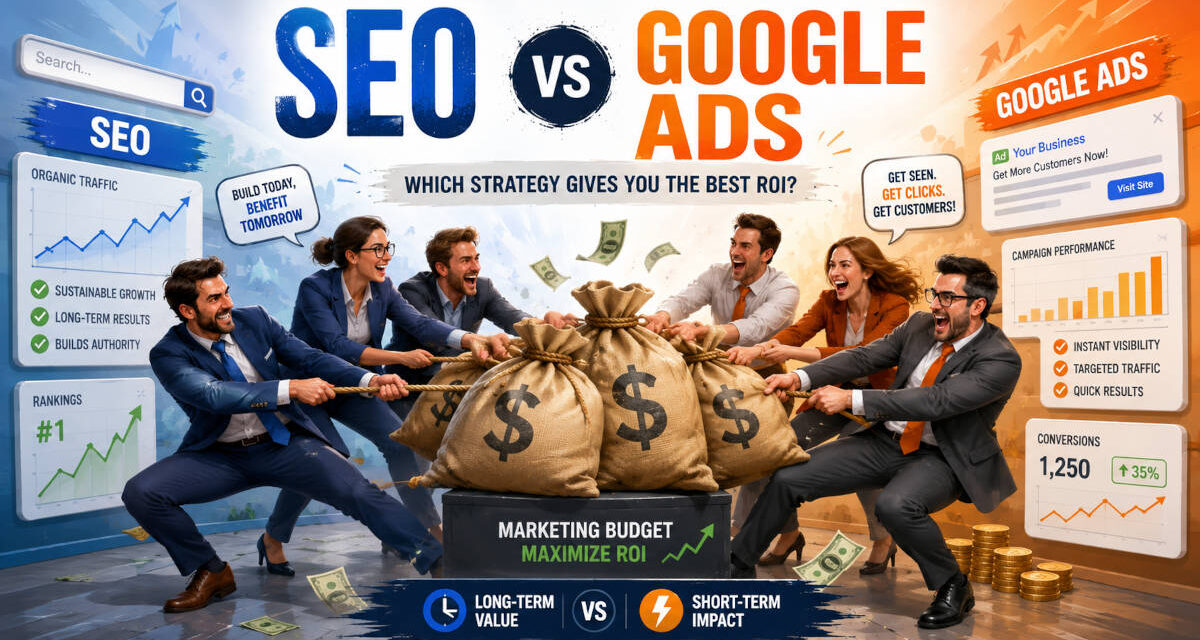
If your business wants more traffic from Google, there are two main ways to get it:
SEO and Google Ads.
Both can put your company in front of people who are actively searching for your products or services, but they work very differently.
SEO focuses on earning visibility in Google’s organic search results.
Google Ads allows you to pay for placement at or near the top of the search results.
So which one is better?
The answer depends on your goals, budget, competition, and how quickly you need results.
For many businesses, the best strategy is not SEO or Google Ads.
It is using both.
What Is SEO?
SEO stands for Search Engine Optimization.
The goal of SEO is to improve your website so that Google is more likely to show your pages when people search for relevant keywords.
For example, a roofing company might want to appear when someone searches:
- Roof repair near me
- Roofing contractor
- Hail damage roof repair
- Roof replacement cost
- Commercial roofing company
SEO attempts to improve those rankings without paying Google every time someone clicks.
That may involve:
- Creating useful website content
- Improving page titles and descriptions
- Building service pages
- Improving website speed
- Fixing technical problems
- Building backlinks
- Improving internal linking
- Creating local business content
- Optimizing Google Business Profile information
- Improving mobile usability
SEO can take time, but successful SEO can generate traffic for years.
What Are Google Ads?
Google Ads allows businesses to pay to appear in Google’s sponsored search results.
You choose keywords you want to target and bid against other advertisers.
For example, a plumbing company could advertise for:
emergency plumber Austin
When someone searches that phrase, the company may appear near the top of the search results.
If the person clicks the ad, the business pays Google.
This is commonly called pay-per-click advertising, or PPC.
The cost of a click can vary dramatically.
Some keywords may cost only a few dollars.
Highly competitive keywords in industries such as legal services, insurance, home services, or financial services can cost substantially more.
The Biggest Difference: Speed
The biggest advantage of Google Ads is speed.
A properly configured advertising campaign can begin generating traffic almost immediately.
SEO usually cannot.
A new website may require months of work before it begins ranking well for competitive keywords.
That makes Google Ads particularly useful when:
- Launching a new business
- Launching a new website
- Promoting a limited-time offer
- Entering a new market
- Testing a new service
- Generating leads quickly
SEO is generally a longer-term investment.
Google Ads is more immediate.
SEO Usually Takes Longer
Businesses sometimes become frustrated with SEO because progress can be slow.
You may publish a new service page today and not see significant search traffic from it for several weeks or months.
Google has to:
- Discover the page.
- Crawl it.
- Understand the content.
- Compare it with competing pages.
- Determine whether the website is trustworthy.
- Decide where the page should rank.
Competitive search terms can take even longer.
If ten established competitors have been investing in SEO for years, a new website probably will not jump ahead of them overnight.
SEO tends to reward consistency.
Google Ads Stops When You Stop Paying
This is one of the biggest disadvantages of paid advertising.
Suppose your company spends $3,000 per month on Google Ads.
As long as the campaign is running, you may continue receiving traffic and leads.
Turn off the campaign and the traffic disappears.
SEO works differently.
A page that ranks well can continue attracting visitors even if you reduce your SEO spending.
That does not mean SEO is completely free.
Websites still require maintenance, new content, technical updates, and occasional improvements.
But you are not paying Google every time someone clicks your organic search result.
SEO Can Have Better Long-Term Economics
SEO can become extremely valuable over time.
Consider a page that receives 1,000 visitors from Google every month.
If those same visitors would have cost $5 per click through Google Ads, that traffic would have cost:
$5,000 per month
If the page continues ranking for several years, the value can become substantial.
This is why businesses often treat SEO as an investment.
You spend money creating and improving assets that can continue generating traffic.
Google Ads is closer to renting traffic.
SEO is closer to building an asset.
But SEO Is Not Free
There is a common misconception that SEO means “free traffic.”
The clicks may be free, but getting the rankings usually is not.
Someone still has to:
- Research keywords
- Write content
- Build pages
- Improve the website
- Fix technical problems
- Monitor rankings
- Build links
- Optimize conversion rates
A business can perform much of this work internally.
Otherwise, it may hire an SEO consultant, agency, content writer, or developer.
SEO therefore has a cost.
It is just structured differently from paid advertising.
Google Ads Gives You More Control
Google Ads provides much greater short-term control.
You can choose:
- Which keywords to target
- Which locations to advertise in
- What hours ads appear
- Which devices to target
- How much to spend
- Which landing pages to use
- Which services to promote
This makes Google Ads useful for very specific campaigns.
For example, imagine a contractor wants more deck-building projects but does not want small repair jobs.
The company could focus its advertising around keywords such as:
- Custom deck builder
- New deck construction
- Composite deck installation
- Deck contractor
The company can also exclude search terms that are unlikely to generate profitable work.
That level of control is much harder with SEO.
SEO Can Attract Broader Traffic
SEO often captures a wider range of searches.
People do not always search exactly the way businesses expect.
A potential customer might search:
“how much does it cost to replace a deck”
Another might search:
“best decking material for Texas heat”
Another could search:
“should I repair or replace my old deck”
These searches may not immediately look like direct sales leads.
But they can introduce customers to your company early in the buying process.
Useful blog posts and informational pages can therefore generate traffic that a narrowly focused advertising campaign might miss.
Google Ads Is Great for Testing Keywords
One of the best uses of Google Ads is learning which keywords actually generate customers.
SEO tools can estimate search volume.
They cannot always tell you which searches will produce profitable leads for your particular business.
Advertising provides real data.
Suppose a company thinks these three phrases are valuable:
- Custom software company
- Software developer
- Business software development
You can run ads targeting all three.
After several months, you may discover that one keyword produces high-quality leads while another generates mostly job seekers or students.
That information can then influence your SEO strategy.
Instead of spending six months trying to rank for a keyword that does not convert, you can focus on the search terms that have already proven valuable.
Google Ads Can Get Expensive
The major disadvantage of Google Ads is cost.
You are competing against other businesses for the same customers.
If several companies are willing to pay aggressively for clicks, prices rise.
Imagine paying $15 per click.
One hundred visitors would cost:
$1,500
If only five become leads and one becomes a customer, the economics of that campaign depend entirely on the value of the sale.
For a company selling a $50 product, that would probably be terrible.
For a contractor landing a $50,000 remodeling project, it might be excellent.
The important metric is not simply cost per click.
It is cost per profitable customer.
SEO Can Also Become Very Competitive
Paid advertising is not the only competitive environment.
SEO can be extremely competitive too.
If you search for something valuable such as:
- Personal injury attorney
- HVAC repair
- Custom home builder
- Software development company
You may be competing against companies that have invested heavily in SEO for years.
Those companies may have:
- Hundreds of pages
- Thousands of backlinks
- Strong domain authority
- Large content teams
- Well-established brands
Ranking above them can require significant work.
This is why businesses should not assume SEO is always the cheaper option.
Sometimes paying for a targeted ad campaign is more practical than trying to rank organically for an extremely competitive keyword.
Local Businesses Can Benefit From Both
Local businesses are particularly good candidates for combining SEO and Google Ads.
Local SEO can help a company appear for searches such as:
- Electrician near me
- Deck builder Austin
- New Orleans web developer
- Pool repair company
- Local roofing contractor
Local SEO typically involves optimizing the website and the company’s Google Business Profile.
Google Ads can then provide additional visibility for the most valuable keywords.
The business can essentially occupy more space on the search results page.
A customer might see:
- Your Google Ad.
- Your Google Business Profile.
- Your organic website listing.
That repeated visibility can strengthen credibility.
SEO Is Better for Educational Content
Google Ads is generally most effective when someone is relatively close to making a purchasing decision.
SEO can reach customers much earlier.
For example, a software development company might publish articles such as:
- Can AI Build an Entire Mobile App?
- Mobile App Maintenance Costs Explained
- Custom Software vs SaaS
- How Much Does a Mobile App Cost?
- Native vs Cross-Platform Mobile Apps
Someone reading those articles may not be ready to hire a developer today.
But they are researching a problem that could eventually lead to a development project.
SEO allows businesses to build relationships with potential customers before those customers start requesting quotes.
Google Ads Is Better for Immediate Purchase Intent
Paid search advertising is especially effective when the search clearly indicates that someone wants to purchase a service.
Consider the difference between:
how does air conditioning work
and:
AC repair company near me
The second search has much stronger commercial intent.
Businesses can use Google Ads to focus heavily on those high-intent searches.
That can generate leads quickly.
SEO Builds Brand Visibility
SEO can also provide value beyond direct leads.
Suppose someone repeatedly searches questions related to your industry and your company keeps appearing in the results.
They may see your business name several times before ever contacting you.
That builds familiarity.
When they are finally ready to make a purchase, your company is no longer completely unknown.
This is particularly useful for high-value services where customers spend days, weeks, or months researching before choosing a provider.
Which Has the Better Conversion Rate?
There is no universal answer.
A highly targeted Google Ads campaign can produce excellent conversion rates.
A well-ranking SEO page can also produce excellent conversion rates.
The biggest factor is usually search intent.
A visitor searching:
“hire mobile app developer”
is much closer to making a purchasing decision than someone searching:
“what is React Native”
Both visitors could be valuable.
They are simply at different stages of the buying process.
A good marketing strategy creates content and campaigns for both.
Use Different Landing Pages for Google Ads
One common mistake is sending every Google Ad to the website’s homepage.
A better approach is often to build focused landing pages.
For example, if someone searches:
custom mobile app development
the ad should probably send them to a page specifically about mobile app development.
If someone searches:
WordPress support company
they should land on a WordPress support page.
The closer the landing page matches the searcher’s intent, the better the chance of converting that visitor into a lead.
This also helps keep advertising campaigns organized and measurable.
SEO Needs Good Landing Pages Too
The same principle applies to SEO.
Do not expect one generic services page to rank for everything.
A development company might have separate pages for:
- Mobile app development
- Custom software development
- Web application development
- WordPress development
- API integration
- AI integration
- Legacy application support
Each page can target a different group of search terms.
This gives Google a clearer understanding of what each page is about.
It also gives visitors more relevant information.
Measuring Google Ads Is Usually Easier
One advantage of Google Ads is that performance can be measured relatively quickly.
You can track:
- Impressions
- Clicks
- Cost per click
- Phone calls
- Form submissions
- Conversion rate
- Cost per lead
With proper conversion tracking, businesses can determine which campaigns, ads, and keywords generate results.
SEO measurement can be less direct.
You can still track rankings, traffic, leads, and conversions, but changes often happen over longer periods.
It may take months to know whether a particular SEO strategy was successful.
SEO Provides Compounding Benefits
Good SEO work can accumulate.
You publish one useful article.
Then another.
Then another.
Those pages begin earning traffic and links.
Internal links connect them to important service pages.
Your website develops more authority around a topic.
Over time, the entire site may become easier to rank.
This compounding effect is one of SEO’s biggest advantages.
Google Ads does not work the same way.
Spending $5,000 on ads last year does not automatically make this year’s clicks cheaper.
Should a New Business Start With Google Ads?
Often, yes.
A brand-new website usually has very little organic authority.
It may take time to build rankings.
Google Ads can generate immediate traffic while the SEO strategy develops.
This gives the business:
- Immediate exposure
- Lead data
- Keyword data
- Conversion data
- Customer behavior information
The company can then use that information to improve its website and SEO strategy.
This is often more effective than waiting six months for organic traffic before learning whether the website converts.
Should You Stop Google Ads Once SEO Works?
Not necessarily.
This depends on profitability.
Suppose your company ranks #1 organically for a valuable search term.
You may decide that paying for ads on the same search is unnecessary.
Or you may discover that appearing in both the ad section and organic results generates even more leads.
The correct decision should be based on data.
If the ads remain profitable, there may be no reason to turn them off.
The Best Strategy: SEO and Google Ads Together
SEO and Google Ads work extremely well together.
Google Ads can provide immediate results.
SEO can build long-term visibility.
A company might use Google Ads for its highest-value commercial keywords while simultaneously developing organic content around those same services.
For example:
Google Ads
Target searches like:
- Hire mobile app developer
- Custom software development company
- WordPress developer near me
SEO
Create service pages and articles around:
- Mobile app development
- Software maintenance
- API integrations
- AI development
- SaaS alternatives
- Development costs
- Technology comparisons
Over time, the company builds a large organic footprint while still using advertising to capture high-intent customers.
SEO vs Google Ads: Quick Comparison
SEO
Advantages
- No cost per organic click
- Long-term traffic potential
- Builds website authority
- Excellent for educational content
- Can produce traffic for years
- Strong long-term value
Disadvantages
- Takes time
- Rankings are not guaranteed
- Competitive keywords can be difficult
- Requires ongoing content and optimization
Google Ads
Advantages
- Immediate visibility
- Precise keyword targeting
- Geographic targeting
- Easy to control budgets
- Excellent for high-intent searches
- Fast performance data
Disadvantages
- Every click costs money
- Competitive keywords can be expensive
- Traffic stops when advertising stops
- Poorly managed campaigns can waste money quickly
Which One Should You Choose?
Choose Google Ads if you need leads quickly and have the budget to pay for traffic.
Choose SEO if you are willing to invest in building long-term organic visibility.
For most established businesses, the best answer is:
Use both.
Google Ads can produce leads today.
SEO can reduce your dependence on paid traffic over time.
The two strategies can also improve each other.
Advertising tells you which keywords generate customers.
SEO allows you to build lasting visibility around those same topics.
The Bottom Line
SEO and Google Ads are not really competitors.
They are two different ways of reaching people through Google.
Google Ads provides speed, targeting, and control.
SEO provides longevity, authority, and the possibility of generating traffic without paying for every click.
If your business needs immediate leads, Google Ads can be extremely effective.
If you want to build a long-term source of website traffic, SEO is difficult to ignore.
The strongest digital marketing strategy often combines them.
Use Google Ads to capture people who are ready to buy now.
Use SEO to build visibility with customers who may be researching today but purchasing tomorrow.
Over time, that combination can create a much more reliable source of leads than depending entirely on either strategy alone.