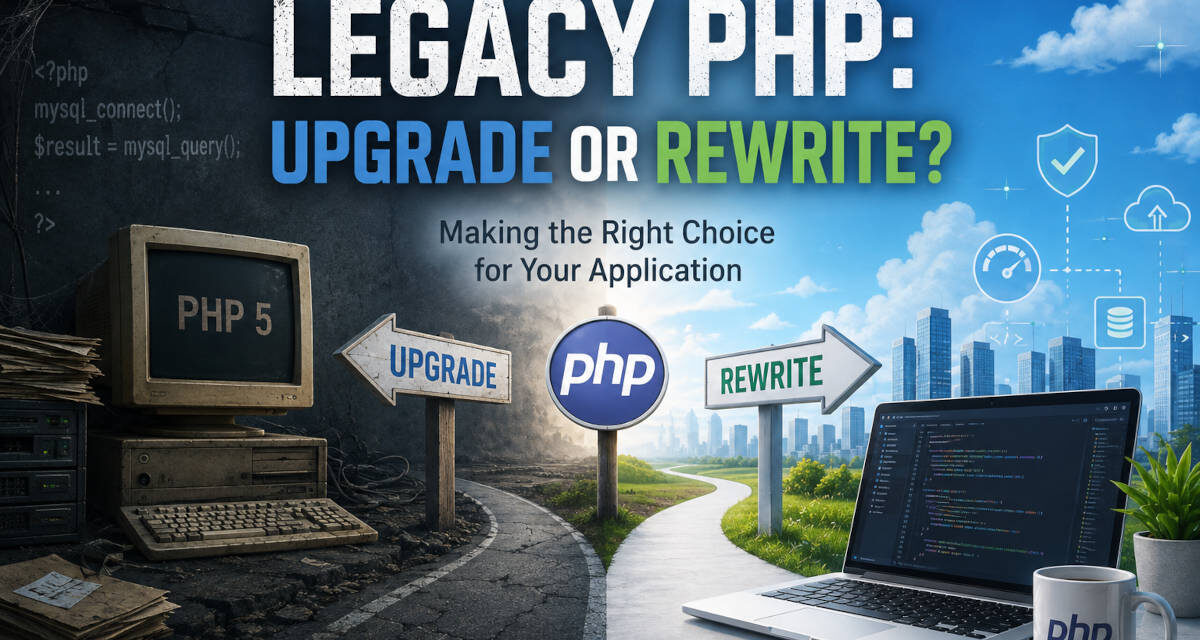
If your business relies on an older PHP application, eventually you will face an uncomfortable question:
Should we upgrade the existing application, or should we rewrite it from scratch?
It sounds like a simple decision, but it rarely is.
Legacy PHP applications can contain years—or even decades—of business logic, integrations, customer data, special exceptions, and workflows that are not documented anywhere except inside the code itself. Rewriting everything may sound cleaner, but it can also introduce significant cost and risk.
On the other hand, continuing to patch an outdated PHP application indefinitely can create security problems, hosting limitations, compatibility issues, and increasingly expensive maintenance.
The right answer depends on the condition of the application, how important it is to the business, and how much of the existing system is worth preserving.
What Is a Legacy PHP Application?
There is no single version of PHP that automatically makes an application “legacy.”
A legacy PHP application is generally an application that has become difficult to maintain because of its age, architecture, dependencies, or technology stack.
For example, an application may still be running on:
- PHP 5
- Early PHP 7 releases
- An outdated PHP framework
- An unsupported version of Laravel, Symfony, Zend Framework, CodeIgniter, or another framework
- Deprecated PHP functions
- Old MySQL libraries
- Custom database code written many years ago
- Third-party APIs that are no longer supported
- Old JavaScript libraries
- Server configurations that are becoming difficult to reproduce
Sometimes the application itself works perfectly well.
That is what makes these projects difficult.
The business may understandably ask:
“If it still works, why change it?”
The problem is that the surrounding technology continues moving forward even when the application does not.
Operating systems change. PHP changes. MySQL changes. Hosting companies discontinue old server configurations. Payment processors update their APIs. Security standards evolve.
Eventually, maintaining the environment required to keep the application alive becomes increasingly difficult.
Option 1: Upgrade the Existing PHP Application
An upgrade attempts to preserve as much of the existing application as possible while modernizing the technology underneath it.
For example, an application running PHP 5 might be modified so that it works correctly on a current PHP environment.
This could involve replacing deprecated functions, updating database connections, fixing incompatible libraries, upgrading the framework, and modifying portions of the application that depend on outdated PHP behavior.
For many applications, this is the most practical approach.
Advantages of Upgrading
The biggest advantage is that you are keeping software that has already been tested in the real world.
A mature business application may contain thousands of small rules that employees and customers depend on every day.
Those rules may include things like:
- Pricing calculations
- Customer permissions
- Reporting logic
- Inventory rules
- Order processing
- Billing procedures
- Data imports and exports
- Email notifications
- Administrative workflows
- API integrations
Much of this functionality may never have been formally documented.
When upgrading the existing application, the underlying business logic can often remain intact.
That can dramatically reduce the risk of accidentally removing an important feature.
Upgrading Can Also Be Faster
A full rewrite can easily become a major software development project.
An upgrade may allow developers to concentrate specifically on compatibility problems rather than recreating every feature in the application.
For example, developers might replace obsolete database functions, update authentication code, correct PHP warnings and errors, and modernize specific libraries without redesigning the entire application.
This can make an upgrade considerably less expensive than starting over.
When an Upgrade Makes Sense
Upgrading is often a good choice when the application still performs its core job effectively.
Good candidates usually have several of these characteristics:
- The business logic is still valuable.
- Users understand and like the existing workflow.
- The database structure is reasonably sound.
- The application is stable.
- Most problems are related to old PHP code or dependencies.
- The application does not require a complete user-interface redesign.
- The code can be modified without breaking everything around it.
An ugly application is not necessarily a bad application.
There are plenty of older business systems with outdated interfaces that continue performing complicated jobs extremely well.
Replacing them simply because they look old can be an expensive mistake.
The Challenges of Upgrading Legacy PHP
Unfortunately, not every PHP application can be upgraded easily.
One of the biggest problems is dependency chains.
An application might depend on an old framework, which depends on an old library, which depends on behavior that was removed from newer versions of PHP.
Fixing one problem may reveal another.
For example, upgrading an old PHP application may require replacing code involving:
mysql_*database functionscreate_function()- Old constructors
- Deprecated string handling
- Removed PHP extensions
- Outdated encryption methods
- Old session management
- Deprecated framework components
A developer may initially fix the first set of errors only to discover additional issues once the application begins running.
That is why legacy PHP upgrades need to be tested carefully.
Option 2: Rewrite the Application
Sometimes the existing application has reached the point where continuing to modify it no longer makes financial sense.
In that situation, a rewrite may be the better long-term solution.
A rewrite means rebuilding the application using a modern architecture rather than continuously modifying the original codebase.
The new application might use a modern PHP framework such as Laravel or Symfony, or the business may decide to move portions of the application to a completely different technology stack.
A rewrite also creates an opportunity to reconsider how the application works.
Instead of recreating every old screen exactly, developers can evaluate which features are still needed and which were created to solve problems that no longer exist.
Contact Us Today for a Free Consultation
Advantages of Rewriting
The biggest advantage is architectural freedom.
Developers are no longer constrained by decisions that were made 10 or 20 years ago.
A modern application can include:
- Cleaner code organization
- Modern security practices
- Better API support
- Improved authentication
- Responsive interfaces
- Automated testing
- Modern database access
- Cloud deployment
- Better logging and monitoring
- Easier integration with third-party services
A cleaner architecture can also make future development faster.
Features that once required modifying several unrelated PHP files may become much easier to implement in a well-structured modern application.
The Biggest Risk of a Rewrite
The biggest danger is underestimating what the existing application actually does.
A legacy application that has been used for 15 years probably contains 15 years of accumulated business knowledge.
Some of that knowledge may be hidden in seemingly insignificant pieces of code.
For example, an old application might contain a special pricing calculation added eight years ago for one major customer.
Nobody remembers requesting it.
Nobody documented it.
But the customer still depends on it.
During a rewrite, that rule can easily disappear.
This is one reason software rewrites frequently become larger projects than originally expected.
Developers are not simply rebuilding software.
They are reverse-engineering years of business decisions.
Another Risk: The Never-Ending Rewrite
There is also a common temptation to improve everything during a rewrite.
If you are rebuilding the application anyway, why not add a new reporting system?
And a customer portal?
And mobile support?
And a new billing platform?
And an AI assistant?
Soon, what began as a replacement project becomes an entirely new product.
The timeline expands, the budget increases, and the legacy application still has to remain operational while the new system is being developed.
This is one of the reasons a controlled modernization strategy can sometimes be safer than a complete rewrite.
The Hybrid Approach
Fortunately, upgrading and rewriting are not always mutually exclusive.
For many applications, the best strategy is a gradual modernization.
Instead of replacing the entire application at once, developers can stabilize the existing system and then replace pieces of it over time.
For example:
Step 1: Move the application to a supported hosting environment.
Step 2: Upgrade the PHP code enough to run on a modern PHP version.
Step 3: Replace obsolete database and security components.
Step 4: Add an API layer around important business functionality.
Step 5: Gradually rebuild individual modules.
This approach allows the business to continue using the existing application while newer components are developed.
It also reduces the risk associated with a single large cutover.
Start With the Infrastructure
Sometimes the immediate problem is not really the application.
It is the server.
We regularly see legacy applications that continue running reliably but depend on an operating system, PHP version, or database server that is no longer practical to maintain.
In that situation, the first goal may simply be to stabilize the environment.
That might mean recreating the server in a virtual machine or cloud environment, documenting the configuration, securing the system, and creating reliable backups.
Once the application is no longer at risk of disappearing because an old physical server fails, there is more time to make a sensible modernization decision.
This can be especially important for older PHP and MySQL applications where replacing the entire application may require months of development.
Look at the Database Before Making a Decision
The database is often more important than the PHP code.
An application may have accumulated years of valuable customer, transaction, inventory, project, or operational data.
Before deciding whether to upgrade or rewrite, developers should examine the database carefully.
Questions to ask include:
- Is the database structure understandable?
- Are relationships between tables consistent?
- Are important fields properly indexed?
- Is the application storing duplicate data?
- Are there undocumented tables?
- Are there stored procedures or triggers?
- How much historical data needs to be preserved?
- Can the existing database be used by a new application?
In some cases, the best solution is to build a new application while continuing to use much of the existing database.
In others, the database itself needs to be redesigned and migrated.
Security Should Be Part of the Decision
Security is one of the strongest reasons to address a legacy PHP system.
Older PHP environments may rely on unsupported software that no longer receives security updates.
The application itself may also use development practices that were common years ago but are no longer considered safe.
Potential concerns include:
- SQL injection vulnerabilities
- Weak password storage
- Inadequate session security
- Missing CSRF protection
- Unsafe file uploads
- Outdated encryption
- Exposed error messages
- Unsupported third-party libraries
A security audit can help determine whether the existing application can reasonably be modernized or whether deeper architectural changes are necessary.
Don’t Rewrite Just Because the Code Is Old
Old code does not automatically mean bad code.
A 15-year-old PHP application that processes thousands of transactions correctly every month has something extremely valuable:
A long history of real-world testing.
A brand-new application does not have that.
The question should not be:
“How old is this application?”
The better question is:
“How difficult will this application be to safely maintain over the next five years?”
If the answer is “not very difficult,” an upgrade may be the logical choice.
If every small change requires working around obsolete architecture and unsupported dependencies, a rewrite becomes more attractive.
Don’t Upgrade Forever Either
There is an opposite mistake.
Some organizations continue patching legacy software long after the cost of maintaining it exceeds the cost of replacing it.
Developers may spend hours solving problems that would be trivial in a modern framework.
Eventually, technical debt begins affecting the business.
New integrations become difficult.
Developers are reluctant to modify the application.
Server migrations become complicated.
Security concerns increase.
At that point, continuously upgrading the old code may simply postpone an unavoidable rewrite.
How We Evaluate a Legacy PHP Application
Before recommending an upgrade or rewrite, a development team should first understand what is actually there.
A good technical evaluation typically looks at:
PHP Version and Code Compatibility
How much code depends on functionality that has been deprecated or removed?
Framework
Is the application using a framework? Can it be upgraded, or has the framework itself become obsolete?
Database
What database technology is being used, and how tightly is the PHP code coupled to it?
Third-Party Dependencies
Does the application depend on unsupported APIs, libraries, payment gateways, or external services?
Server Environment
Can the application run reliably on modern hosting infrastructure?
Security
Are there architectural security issues that would be difficult to correct without significant changes?
Business Logic
How much unique functionality would have to be recreated during a rewrite?
Documentation
Is the application documented, or will developers need to reverse-engineer most of its behavior?
Future Requirements
What does the business expect the application to do over the next several years?
The answer to the upgrade-versus-rewrite question becomes much clearer once these factors are understood.
Upgrade or Rewrite? There Is No Universal Answer
For some legacy PHP applications, an upgrade is clearly the best option.
The application performs its job well, the underlying architecture is reasonable, and most of the work involves making the code compatible with modern PHP and hosting infrastructure.
For others, years of patches and outdated architecture have made the application too difficult to maintain. Continuing to upgrade it simply delays the inevitable.
And in many cases, the best solution lies somewhere in between: stabilize the legacy application, modernize the most critical components, and gradually replace the system over time.
The most important thing is not to make the decision based solely on the age of the code.
A legacy PHP application represents both technical debt and accumulated business knowledge.
A successful modernization project needs to address the first without accidentally throwing away the second.
Need Help With a Legacy PHP Application?
Legacy PHP projects can be difficult because there is rarely a simple upgrade button.
Every application has its own combination of PHP versions, frameworks, databases, server configurations, integrations, and business logic.
Whether your application needs a PHP upgrade, server migration, code modernization, database conversion, or complete rebuild, the first step is understanding what you currently have.
From there, you can determine whether upgrading, rewriting, or gradually modernizing the application provides the best balance of cost, risk, and long-term maintainability.