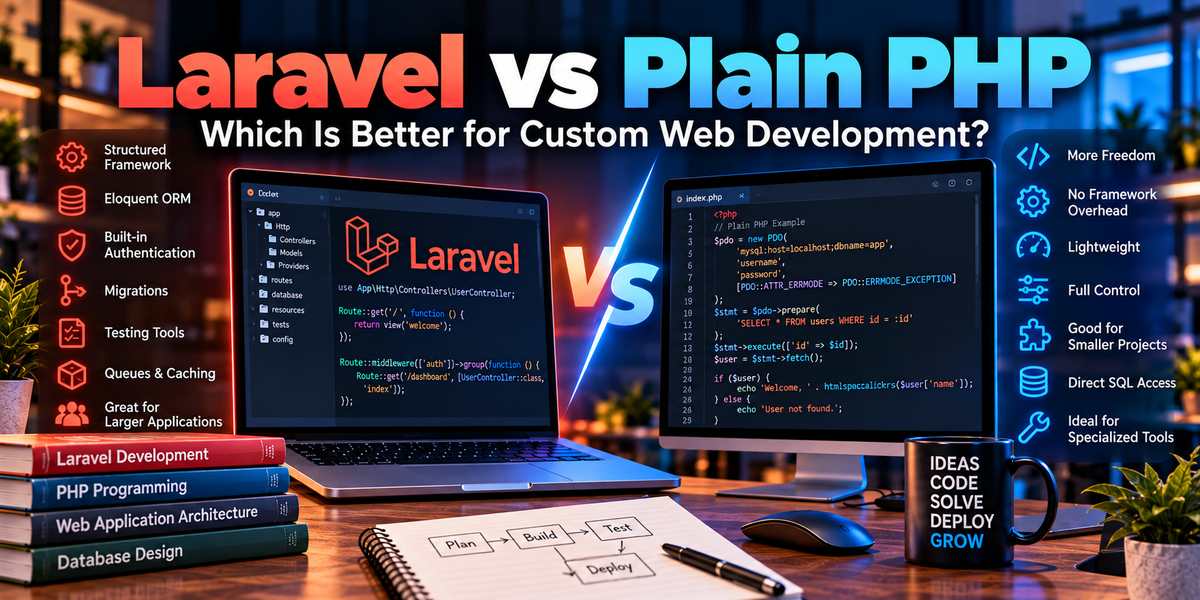
Laravel vs Plain PHP: Which Is Better for Custom Web Development?
PHP has been one of the core technologies behind web development for decades, and it remains an important part of the work we do at Firecane Digital.
But when starting a new PHP application, one of the first architectural decisions is whether to build the application with a framework such as Laravel or write the application using plain PHP.
There is no universal answer.
Laravel provides a structured framework with routing, database tools, authentication support, migrations, testing features, queues, caching, and many other components already organized for developers.
Plain PHP provides much more freedom. Developers can create exactly the application they need without bringing an entire framework into the project.
At Firecane Digital, we have worked with both approaches. We have maintained older PHP applications written almost entirely from scratch, upgraded legacy applications into modern PHP environments, and developed applications using frameworks including Laravel and CodeIgniter.
We have also worked on a real-world Laravel project for StayFi involving PHP, MySQL, Linux, RADIUS authentication, APIs, multiple deployment environments, Git branches, and database migrations. Firecane Digital
So when should you use Laravel, and when does plain PHP make more sense?
The answer depends on the size of the application, how many developers will work on it, how long it will need to be maintained, how much custom functionality is required, and how much structure the project really needs.
What Is Plain PHP?
Plain PHP generally means building an application directly with the PHP language instead of using a full application framework such as Laravel.
That does not necessarily mean writing primitive or poorly organized code.
A well-designed plain PHP application can still use:
- Object-oriented programming
- Classes
- Namespaces
- Composer packages
- Dependency management
- MVC concepts
- Database abstraction
- APIs
- Routing
- Automated testing
- Git
- Docker
- Modern PHP coding standards
The difference is that the development team decides how those pieces are organized rather than following the architecture provided by a framework.
For a very simple application, that freedom can be useful.
There is no reason to install hundreds of framework components just to process a simple form or perform one specialized task.
However, as an application becomes larger, developers often begin writing many of the same systems that established frameworks already provide.
That is where Laravel becomes attractive.
What Is Laravel?
Laravel is an open-source PHP web application framework.
Instead of beginning every new PHP application with an empty directory, Laravel provides an organized foundation for building modern web applications.
Laravel includes tools for routing, database access, migrations, authentication, validation, queues, caching, email, testing, API development, scheduling, and other common application requirements.
Laravel describes itself as providing the structure and starting point for an application so developers can focus on the application’s unique functionality rather than rebuilding common infrastructure. Laravel
Laravel is also actively developed. Laravel 13 is the current major generation in 2026, while Laravel’s documented support schedule continues to provide defined bug-fix and security-support windows for each major release. Laravel
Laravel vs Plain PHP: The Basic Difference
The simplest way to think about the difference is this:
Plain PHP gives you maximum freedom. Laravel gives you an established structure.
With plain PHP, you decide how routing works.
You decide how database models work.
You decide where controllers go.
You decide how validation works.
You decide how authentication is organized.
You decide how database changes are tracked.
With Laravel, conventions for many of these things already exist.
That can save an enormous amount of development time on larger applications.
The tradeoff is that developers need to understand Laravel itself in addition to PHP.
A Simple PHP Application May Not Need Laravel
Laravel is powerful, but not every PHP project needs a framework.
Suppose you need a small internal tool that accepts several values from a form, performs a calculation, stores the result in a database, and generates a PDF.
That application might contain only a handful of PHP files.
Building the entire project in Laravel could add unnecessary complexity.
A well-written plain PHP application could be easier to understand, faster to deploy, and simpler to maintain.
We encounter this fairly often.
Sometimes the best technical solution is not the largest or most sophisticated technology stack.
Good software development involves choosing the simplest architecture that reliably solves the problem.
Larger Applications Benefit From Structure
The calculation changes when the application becomes larger.
Imagine instead that the system contains:
- Customer accounts
- Employee accounts
- Administrative users
- Multiple permission levels
- A customer database
- Payment processing
- API integrations
- Reporting
- Email notifications
- Scheduled processes
- Document uploads
- Mobile app connections
- Hundreds of application screens
Now organization becomes extremely important.
Without a consistent architecture, developers can gradually create a collection of PHP files that depend on each other in complicated ways.
One file includes another file.
That file includes three more.
Database queries are scattered throughout the application.
Authentication logic appears in multiple directories.
Business rules are duplicated.
After several years and several developers, making even a small change can become risky.
Laravel provides conventions that help prevent this kind of development from becoming chaotic.
Laravel Provides a Consistent Application Structure
One of Laravel’s biggest advantages is that another Laravel developer generally knows where to start looking.
Routes are organized in predictable locations.
Controllers have a defined role.
Models generally interact with the database.
Middleware can handle requests before they reach application logic.
Configuration has established locations.
Database migrations document changes to the schema.
This does not automatically guarantee good code.
A developer can still build a terrible Laravel application.
But the framework provides guardrails.
That becomes especially valuable when several developers work on the same project.
Plain PHP Gives Developers More Freedom
The greatest advantage of plain PHP is also one of its greatest risks.
There are very few restrictions.
If we need a small endpoint that receives JSON, performs a database lookup, and returns a response, we can create exactly that.
There is no need to create an entire framework application.
That can make plain PHP extremely efficient for:
- Small utilities
- Specialized scripts
- Data import tools
- Cron jobs
- Simple APIs
- Legacy system integrations
- Lightweight internal applications
It is also useful when working inside an existing custom application.
Not every older PHP system should be rewritten just because modern frameworks exist.
We recently discussed this in more detail in our article about whether to upgrade or rewrite legacy PHP applications.
Sometimes upgrading the existing code is significantly more practical than replacing the entire application.
Laravel’s MVC Architecture
Laravel applications generally follow the Model-View-Controller approach.
The concept is straightforward.
The Model deals primarily with application data.
The View handles presentation.
The Controller coordinates requests and application logic.
This separation can make large applications considerably easier to understand.
For example, instead of putting a database query, form validation, calculations, and HTML output into one PHP file, those responsibilities can be separated into logical components.
That becomes increasingly valuable as an application grows.
Plain PHP can absolutely use MVC architecture as well.
The difference is that Laravel already gives developers a standardized implementation.
Database Development: Laravel Eloquent vs Plain SQL
Database access is another major difference.
In plain PHP, developers may use PDO or MySQLi to communicate directly with MySQL or MariaDB.
For example, an application might execute a SQL query and process the resulting records manually.
That approach provides direct control and can be extremely efficient.
Laravel offers an Object Relational Mapper called Eloquent.
Eloquent allows database records to be represented as PHP objects.
Instead of manually writing every SQL statement, developers can use models and relationships to work with application data.
This can make complicated applications easier to read.
For example, rather than manually joining customers to orders in multiple places, an application can define the relationship once and use it throughout the system.
That convenience is one of the reasons Laravel is attractive for database-heavy business applications.
There Are Times We Still Prefer SQL
ORMs are useful, but they do not eliminate the need to understand databases.
We still believe developers working with database applications should understand SQL.
Sometimes a complicated reporting query is clearer and more efficient when written directly.
Large data imports, analytics, aggregation, and specialized database operations may also benefit from custom SQL.
One danger of relying completely on an ORM is that developers can forget what is actually happening at the database level.
An innocent-looking piece of application code can sometimes generate dozens or hundreds of database queries.
Good Laravel developers still need to understand SQL, indexing, joins, database normalization, and query performance.
Laravel Database Migrations Are Extremely Useful
One Laravel feature we particularly like for team development is database migrations.
A migration describes a database change as code.
For example, a developer might create a migration that adds a phone_number column to the customer table.
That migration becomes part of the Git repository.
Other developers can then apply the same database change to their environments.
The change can move from development to staging and then into production.
This solves an old problem in PHP development:
“Did everybody remember to manually add that database column?”
On our StayFi Laravel project, the development workflow included Git branches and Laravel Artisan database migrations across development, staging, and production environments. Firecane Digital
For larger applications, that type of repeatable deployment process can be extremely valuable.
Laravel’s Artisan Command-Line Tool
Laravel includes a command-line interface called Artisan.
Artisan can automate many common development tasks.
Developers can use it to generate application components, run database migrations, execute scheduled jobs, clear caches, create test files, and perform many other operations.
For example:
php artisan migratecan execute pending database migrations.
The official Laravel installation documentation uses Artisan migrations as a standard part of configuring a new database-backed Laravel application. Laravel
This may seem like a minor convenience, but these tools add up across a large development project.
Authentication and Security
Authentication is another good example of why frameworks can save development time.
Building a secure authentication system involves much more than creating a username and password form.
Developers need to think about:
- Password hashing
- Sessions
- Authentication state
- Password resets
- CSRF protection
- Validation
- Permissions
- Rate limiting
- Secure cookies
- Account verification
It is certainly possible to build all of this in plain PHP.
We have.
But if a framework already provides well-tested components and established patterns, rebuilding all of those systems may not be the best use of development time.
Laravel includes substantial infrastructure for authentication and authorization, while starter kits can provide common application functionality.
Validation Is Another Framework Advantage
Nearly every business application contains forms.
Those forms need validation.
Is the email address actually formatted as an email?
Is a required field missing?
Is the ID numeric?
Does the customer already exist?
Is an uploaded file an allowed type?
Laravel has a structured validation system that makes these rules relatively easy to define consistently throughout an application.
In plain PHP, developers usually build or adopt their own validation system.
Again, that is not necessarily bad.
The question is whether the project is large enough to justify reinventing that infrastructure.
Laravel Makes API Development Easier
Modern applications frequently need APIs.
A mobile application might communicate with a PHP backend.
A website may exchange data with a CRM.
A customer portal may retrieve information from several other business systems.
Laravel provides routing, request handling, JSON responses, authentication tools, middleware, validation, queues, and database functionality that can make API development substantially faster.
This is one reason Laravel works well as the backend for mobile applications.
A company may have an iPhone app, Android app, administrative website, and customer portal all communicating with the same Laravel API.
Firecane works with these kinds of integrations as part of our custom software and mobile app development projects.
Plain PHP Can Be Excellent for APIs Too
A small API endpoint does not necessarily require Laravel.
If an application needs only a handful of specialized endpoints, plain PHP can be extremely efficient.
The endpoint can receive the request, validate it, perform the required operation, and return JSON.
There may be very little benefit in introducing an entire framework.
But once the API contains dozens or hundreds of endpoints with authentication, permissions, database models, rate limiting, logging, and versioning, a structured framework becomes much more attractive.
Laravel Has Built-In Testing Support
Testing is another important difference.
Laravel is designed with automated testing in mind and includes support for tools such as PHPUnit and Pest. Its standard application structure separates unit and feature tests, and the framework provides helper functionality specifically for application testing. Laravel
Plain PHP applications can also have excellent automated testing.
There is nothing stopping a developer from using PHPUnit with plain PHP.
But Laravel makes testing part of the expected development structure rather than something the developer must assemble independently.
For long-lived business applications, automated testing can become increasingly valuable as new features are added.
Testing Matters More as Applications Grow
A small application might be easy to test manually.
A developer makes a change, submits a few forms, checks the database, and confirms the feature still works.
That becomes much harder when an application has hundreds of features.
Changing the customer account system could unexpectedly affect billing.
Changing a database model could affect reporting.
Updating authentication could affect a mobile API.
Automated tests help identify those unintended consequences.
That is one reason we are more likely to recommend a framework for applications expected to grow substantially over time.
Laravel and Queues
Not every application task should happen while a customer waits for a page to load.
Suppose a user uploads a spreadsheet containing 100,000 records.
The application might need to process that data, communicate with several APIs, create PDF files, and send notifications.
Trying to perform everything during one browser request may cause the request to time out.
Laravel provides queue systems that allow time-consuming tasks to run in the background.
Examples include:
- Email processing
- Large imports
- Report generation
- Image processing
- API synchronization
- Notifications
- Data conversions
You can absolutely build queue systems in plain PHP.
But this is another example of functionality Laravel already provides.
Scheduling and Cron Jobs
Business applications frequently contain scheduled tasks.
A process may need to run every night.
Reports may need to be generated every Monday.
An API may need to synchronize every hour.
Laravel provides a task scheduling system that can centralize much of this logic inside the application.
Plain PHP applications typically accomplish similar tasks through server cron jobs and custom scripts.
Both approaches work.
Laravel simply creates a more standardized interface for managing them.
Laravel and Email
Sending email sounds simple until the application needs to support templates, queues, multiple providers, attachments, notifications, and error handling.
Laravel includes a mail system designed to work with different email services and application environments.
For a large business application generating many types of email, this can substantially reduce development time.
A small plain PHP application sending one notification may have no need for that additional abstraction.
Again, application scale matters.
Laravel Makes Team Development Easier
One of the strongest arguments for Laravel is not necessarily a technical feature.
It is developer familiarity.
If a new developer joins a well-organized Laravel project, that developer already understands many of the architectural conventions.
They know where routes are likely located.
They understand controllers.
They understand Eloquent models.
They recognize migrations.
They know how configuration generally works.
A completely custom PHP application may require considerably more time before a new developer understands how the original programmer organized everything.
This is particularly important for business software expected to remain in service for many years.
Plain PHP Can Become Too Dependent on One Developer
We have inherited many older PHP applications over the years.
Some are extremely well organized.
Others make sense only to the person who originally wrote them.
You may encounter files such as:
functions.php
functions2.php
functions-new.php
common.php
includes.php
stuff.php
One giant file may contain 10,000 lines of unrelated functions.
Database credentials may be scattered through several directories.
SQL queries may appear directly inside HTML.
That is not a problem with PHP.
It is an architecture problem.
Laravel does not automatically eliminate poor architecture, but a framework makes this kind of completely improvised application structure less likely.
Laravel Does Have Overhead
Frameworks are not free from a technical perspective.
Laravel introduces a large amount of functionality.
That means more dependencies, more files, more abstractions, and a larger learning curve.
For a tiny application, that can be unnecessary.
A plain PHP script might perform the required task with a few hundred lines of code.
The equivalent Laravel project would contain considerably more infrastructure.
That is why we do not believe every PHP project automatically needs Laravel.
Performance: Is Plain PHP Faster Than Laravel?
Plain PHP can absolutely be faster for a small, specialized task.
If the server only needs to execute several functions and return a result, there is less framework infrastructure to initialize.
However, raw execution speed is only one part of application performance.
A badly designed plain PHP application can be extremely slow.
A properly optimized Laravel application can perform very well.
Application performance depends on factors including:
- Database design
- Query efficiency
- Caching
- Server configuration
- PHP version
- Application architecture
- External APIs
- Session handling
- File operations
The framework matters, but it is not the only factor.

Modern PHP Is Much Better Than Old PHP
It is also worth distinguishing modern plain PHP from the PHP applications many people remember from 15 or 20 years ago.
PHP itself has evolved substantially.
As of 2026, PHP 8.5 is an actively maintained release line, while PHP 8.6 is in pre-release development. PHP.net
Modern PHP supports strong object-oriented programming patterns, type declarations, namespaces, attributes, exceptions, Composer packages, and many features that make structured development easier.
You do not need Laravel simply to write professional PHP code.
Laravel is a framework built on top of an already capable programming language.
Laravel Has a Learning Curve
A developer who knows PHP does not automatically know Laravel.
Laravel introduces its own concepts, conventions, and terminology.
Developers need to understand:
- Routing
- Controllers
- Models
- Eloquent
- Blade
- Middleware
- Service containers
- Providers
- Migrations
- Artisan
- Queues
- Events
- Configuration
- Composer
For experienced Laravel developers, these features accelerate development.
For someone completely new to the framework, they can initially slow development down.
That is another reason why the development team’s existing experience matters when selecting a technology.
Laravel Also Requires Maintenance
Using a framework does not eliminate maintenance.
In some ways, it adds another layer of maintenance.
Developers need to maintain:
- PHP
- Laravel
- Composer packages
- JavaScript packages
- Database servers
- Application code
- Third-party integrations
Laravel has regular major releases, and major framework releases can include breaking changes. Laravel documents defined bug-fix and security-support periods and recommends upgrading applications as versions age out of support. Laravel
That is good from a security and development standpoint, but businesses should understand that framework applications still require ongoing maintenance.
Plain PHP May Be Easier to Keep Running for a Long Time
This is one area where plain PHP sometimes has an advantage.
A simple custom PHP application with few dependencies can sometimes operate for years with relatively little framework-specific maintenance.
There is no framework version that must be upgraded.
However, PHP itself still changes.
Functions become deprecated.
Database extensions disappear.
Security practices evolve.
Server operating systems change.
We have worked on older PHP applications that continued operating for many years and then suddenly became difficult to migrate because they depended on obsolete versions of PHP and MySQL.
So plain PHP does not eliminate technical debt.
It simply creates a different type of technical debt.
Laravel Is Often Better for New Large Applications
If we were beginning a substantial new business application with multiple developers, a database, user accounts, APIs, administrative functionality, and years of expected future development, Laravel would usually deserve serious consideration.
The framework provides too many useful components to ignore.
It also gives the team a common architecture.
That can make development faster today and maintenance easier years from now.
Plain PHP Is Still a Good Choice for Smaller Tools
At the same time, we would not build a Laravel application simply because Laravel is popular.
Plain PHP remains an excellent choice for smaller utilities and specialized systems where a framework would provide little benefit.
Examples might include:
- Small data-processing scripts
- Import and export tools
- Specialized API endpoints
- Custom WordPress integrations
- Simple administrative utilities
- Legacy application additions
- Cron scripts
- Server utilities
The key is keeping the code organized even when a framework is not being used.
What About WordPress?
WordPress is another PHP application, but it represents a different development model.
WordPress itself acts as a content management framework and provides its own plugin system, database APIs, hooks, authentication, administration interface, and application structure.
If we are building functionality specifically for WordPress, it usually makes sense to use WordPress APIs rather than adding Laravel inside the site.
However, there are situations where a WordPress website may communicate with a separate Laravel application through an API.
For example, WordPress could manage public marketing content while Laravel operates a custom customer portal or business system behind the scenes.
The best architecture depends on the project.
Laravel Works Well With Mobile Applications
Laravel can also be an excellent backend for mobile applications.
The iOS or Android app does not necessarily need to know or care that Laravel exists.
The mobile application communicates with an API.
Laravel handles authentication, database operations, business logic, notifications, and integrations on the server.
This separation can allow the same backend to support:
- iPhone apps
- Android apps
- Web applications
- Administrative portals
- Third-party integrations
That can be a very efficient architecture for custom software projects.
Our Real-World Laravel Experience
Our Laravel experience is not limited to test projects.
One of our development projects involved PHP and Laravel for StayFi.
The application was part of a three-tier system that captured guest information through Wi-Fi access points.
The project involved:
- PHP
- MySQL
- Laravel
- Linux/Ubuntu
- RADIUS authentication
- CloudTrax network integration
- MailChimp API integration
- Development environment
- Staging environment
- Production environment
- Git branches
- Laravel Artisan database migrations
The RADIUS server communicated with the Laravel application, which stored captured information and integrated with outside systems. Firecane Digital
You can read more about our PHP Laravel development project for StayFi.
Projects like this are exactly where a framework makes sense.
There are enough moving parts that consistent architecture, migrations, environments, source control, and framework tools provide real value.
Laravel vs Plain PHP for Legacy Applications
The decision becomes different when dealing with an existing application.
Suppose a company has a 15-year-old custom PHP system that still performs an important business function.
Should we rewrite it in Laravel?
Maybe.
But not automatically.
First we need to understand:
- How large the system is
- How reliable it is
- Which PHP version it requires
- Whether the database design is still usable
- How many users depend on it
- Whether documentation exists
- How frequently the business needs new features
- What integrations it uses
- How expensive continued maintenance has become
Sometimes upgrading the existing PHP application is the most cost-effective solution.
Other times, the architecture has reached the point where rebuilding it in Laravel or another modern framework provides better long-term value.
Our article on Legacy PHP: Upgrade or Rewrite? looks at that decision in more detail.
Laravel vs Plain PHP and AI-Assisted Development
AI coding assistants are also changing this comparison.
Tools such as ChatGPT, Codex, Copilot, Cursor, and Claude can generate both plain PHP and Laravel code.
Laravel’s standardized architecture can actually make AI-assisted development easier in some cases because the AI already understands common Laravel conventions.
If you say “create a Laravel controller, Eloquent model, migration, and API route,” the AI has a well-established architectural pattern to follow.
With a completely custom PHP application, the AI needs more information about your particular architecture.
Laravel has also begun adding AI-specific development tooling. Its documentation now includes Laravel Boost, which can provide framework-aware information and guidelines to supported AI development environments. Laravel
This is another interesting advantage of standardized frameworks as AI becomes a larger part of software development.
Which One Is Easier to Debug?
Both can be debugged effectively.
With plain PHP, the call path may initially be simpler because there are fewer framework layers.
Laravel adds routing, middleware, dependency injection, models, and other abstractions.
However, Laravel also provides extensive logging and development tooling.
We typically use proper local development environments, IDE debugging, logging, and tools such as Xdebug rather than relying entirely on error messages displayed in the browser.
For a well-structured application, either approach can provide an excellent debugging environment.
Which Is More Secure?
Neither Laravel nor plain PHP automatically guarantees security.
Laravel provides secure defaults and built-in systems for many common web-development concerns, which can reduce the chances of developers implementing those features incorrectly.
Plain PHP requires developers to make more of those architectural decisions themselves.
An experienced developer can build an extremely secure plain PHP application.
An inexperienced developer can also create an insecure Laravel application.
Security ultimately depends on:
- Application design
- Developer experience
- Input validation
- Database practices
- Authentication
- Authorization
- Dependency management
- Server configuration
- Updates
- Testing
Frameworks help, but developers are still responsible for using them correctly.
Laravel vs Plain PHP: Which Costs More?
This depends heavily on the project.
For a small application, Laravel may add development time and cost that provides little benefit.
For a large application, Laravel may substantially reduce development cost because developers do not have to build common infrastructure from scratch.
Maintenance costs are also important.
A completely custom architecture may be inexpensive for the original programmer to develop but expensive for another developer to understand five years later.
A well-built Laravel application can make onboarding new developers easier because much of the structure is already familiar.
The initial development cost should therefore not be the only consideration.
Long-term maintenance matters.
When We Would Choose Plain PHP
We would seriously consider plain PHP when the project is relatively small, specialized, and unlikely to become a large application.
It can make sense when:
- The application performs only a few tasks.
- Maximum simplicity is important.
- Performance requirements favor minimal overhead.
- The project needs to integrate into an existing custom PHP system.
- Laravel would add more complexity than value.
- The application is primarily a utility or background process.
Plain PHP remains an extremely useful development option.
When We Would Choose Laravel
Laravel becomes more attractive when the application is larger and expected to evolve.
It is particularly useful when:
- Multiple developers will work on the project.
- The application has many database tables.
- User authentication is required.
- Roles and permissions are important.
- APIs are extensive.
- Automated testing matters.
- Background jobs are needed.
- Database migrations need to be tracked.
- The application will have development, staging, and production environments.
- The software is expected to remain under active development for years.
In those situations, the framework structure can save considerably more time than it costs.
The Best Choice Depends on the Application
There is no reason for Laravel vs plain PHP to become a religious argument among developers.
They are tools.
The correct question is not:
“Which one is better?”
The better question is:
“Which one is better for this application?”
We have seen simple PHP applications become unnecessarily complicated because developers introduced frameworks and dependencies they did not need.
We have also seen large plain PHP applications become extremely difficult to maintain because the original developers tried to build every piece of infrastructure themselves.
Good software architecture is about choosing the right amount of structure.
Final Thoughts: Laravel vs Plain PHP
Plain PHP remains a perfectly legitimate way to build software.
For smaller applications, integrations, utilities, and specialized tasks, it may be the best option.
Laravel becomes increasingly valuable as an application grows.
Its routing, database models, migrations, validation, authentication infrastructure, queues, testing tools, scheduling, and standardized architecture can eliminate a large amount of repetitive development work.
For larger business applications, that structure can also make future maintenance easier.
At Firecane Digital, we do not decide on the framework first and then try to make the project fit it.
We look at what the application actually needs to accomplish.
Sometimes the answer is WordPress.
Sometimes it is plain PHP.
Sometimes it is Laravel.
Sometimes it is a mobile application connected to a custom API.
And sometimes the right answer is to leave an existing legacy system largely intact and carefully modernize the pieces that need attention.
The technology should serve the business requirement, not the other way around.
PHP and Laravel Development From Firecane Digital
Firecane Digital provides custom PHP development, Laravel development, API integration, database development, application modernization, web development, and mobile app development.
Our team has more than 20 years of experience working with custom web applications and business software.
We can work with both modern applications and existing legacy systems.
Our services can include:
- Laravel application development
- Plain PHP development
- PHP upgrades
- Legacy PHP modernization
- MySQL and MariaDB development
- API development
- Third-party API integration
- Database design
- Custom business applications
- WordPress development
- Mobile application backends
- Docker development environments
- Git-based development workflows
- Application migrations
- Cloud deployment
- Debugging and troubleshooting
- Ongoing software maintenance
We have also worked with Laravel in real production environments involving PHP, MySQL, Linux, APIs, RADIUS authentication, Git branches, staging environments, and database migrations.
If your company is planning a new PHP application or trying to determine what to do with an older system, Firecane Digital can help evaluate the existing software and recommend a practical development approach.
Learn more about our PHP Laravel project for StayFi, read our guide to upgrading or rewriting legacy PHP applications, or explore our mobile app development services.
Contact Firecane Digital to discuss your PHP, Laravel, custom software, or legacy application project.